
Why Protecting Your Intellectual Property Is an Ethical Imperative

When most people hear the words “intellectual property,” they picture Silicon Valley tech giants locked in billion-dollar patent battles. But IP protection isn’t just for the big players — it’s one of the most important and often overlooked responsibilities of any entrepreneur, small business owner, or thought leader building something meaningful.
I know this firsthand. Earlier this month, I received federal trademark registration for Let’s talk about Ethics™ (Reg. No. 8,297,796) through the United States Patent and Trademark Office. It was the result of over a year of process, patience, and paperwork — and it was absolutely worth every step.
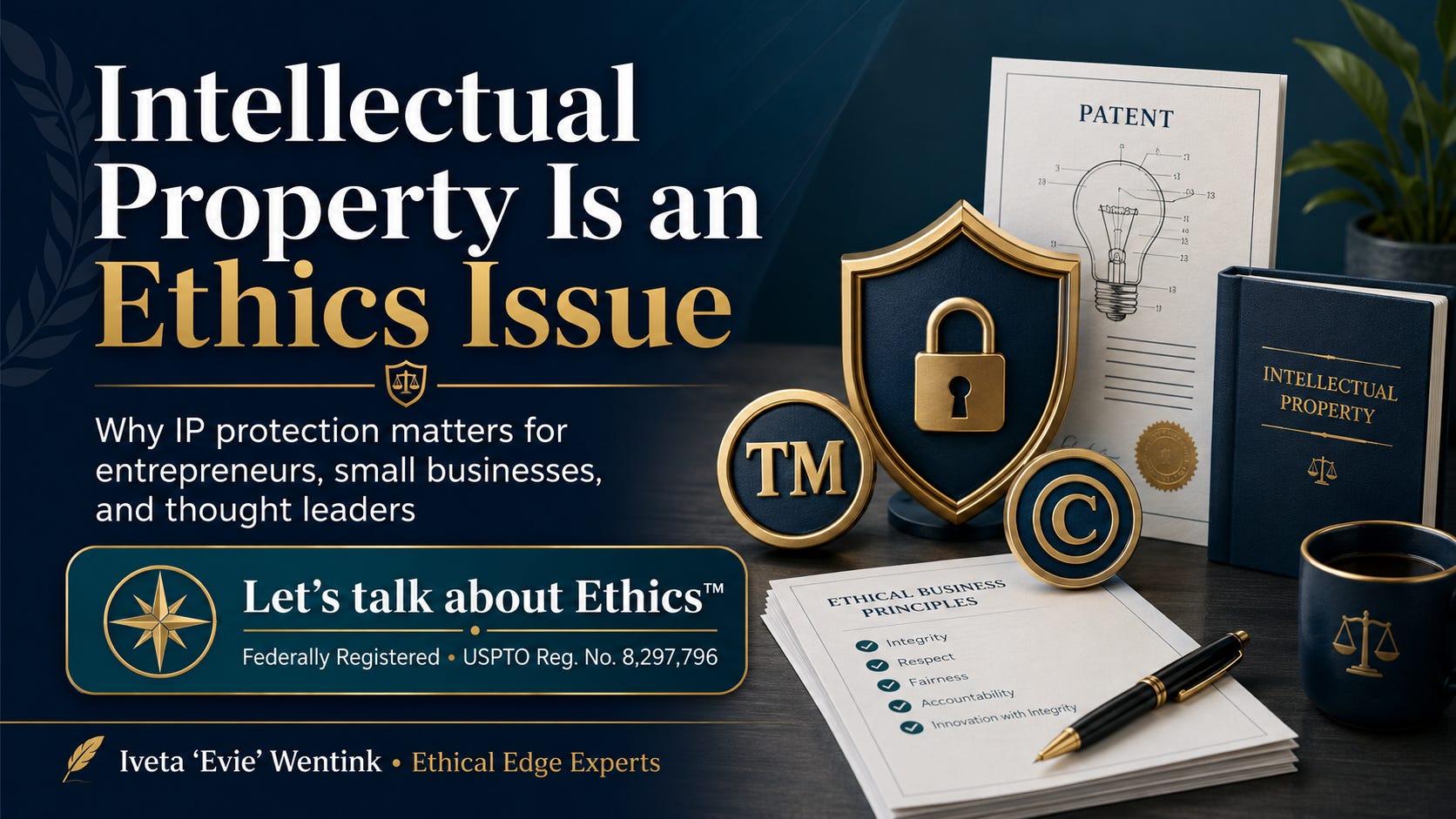
But beyond the personal milestone, it got me thinking: why don’t more people in the business ethics and compliance space talk about IP protection as an ethical issue in and of itself?
They should. Let’s talk about it.
What Is Intellectual Property, and Why Does It Matter?
Intellectual property refers to creations of the mind — brand names, logos, written works, inventions, designs, trade secrets, and more. In the United States, the primary legal tools for protecting IP are:
Trademarks — protect brand identifiers (names, logos, slogans) that distinguish your goods or services
Copyrights — protect original creative works like writing, art, music, and software
Patents — protect inventions and novel processes
Trade secrets — protect confidential business information that gives you a competitive edge
Each of these tools exists because society has recognized something fundamental: when people create something valuable, they deserve the right to benefit from it. That’s not just a legal principle. It’s an ethical one.
The Ethics of IP: More Than Just Legal Compliance
Here’s where this gets interesting for those of us in the ethics and compliance world.
IP protection is often framed as a purely legal matter — something you hand off to an attorney and forget about. But the decision to protect (or not protect) your intellectual property has real ethical dimensions.
Protecting your IP is an act of integrity.
When you trademark your brand, you’re making a commitment: this is who I am, this is what I stand for, and I am serious enough about it to formalize it. It signals to your clients, partners, and competitors that your work has value — and that you know it.
Conversely, failing to protect your IP can create ethical risks you may not have considered:
Consumer confusion. Without a registered trademark, someone else can use a similar name or brand in your industry, leaving your audience unsure of who they’re actually doing business with. That ambiguity isn’t just inconvenient — it can be genuinely harmful.
Unfair competition. If a bad actor copies your brand or methodology and delivers inferior results under a similar name, your reputation suffers for work you didn’t do.
Undermining your mission. For those of us in the ethics space, the stakes are especially high. If someone were to operate under a similar brand while behaving unethically, the damage to the broader conversation we’re trying to advance could be significant.
The Ethical Obligation to Respect Others’ IP
The flip side of protecting your own intellectual property is respecting others’. And this is where compliance culture has a real role to play.
IP infringement — whether intentional or not — is one of the most common legal and ethical violations in business today. Organizations that don’t take it seriously expose themselves to significant legal liability. But beyond the legal risk, there’s a values question: are we the kind of organization that takes credit for others’ work?
For businesses committed to ethical culture, IP respect should be embedded into everyday operations:
Do your teams know what they can and cannot reproduce, adapt, or distribute? Copyright education matters.
Does your procurement process include IP due diligence? Using a vendor’s proprietary process without proper licensing is infringement, even if unintentional.
Do your employees understand that internal training materials, presentations, and tools may be protected? Many businesses don’t, and the resulting exposure can be significant.
What I Learned Going Through the Trademark Process
Pursuing federal trademark registration for Let’s talk about Ethics™ was its own kind of education.
The process took time — from filing in October 2024 to registration in June 2026. It required demonstrating first use in commerce, navigating USPTO requirements, and patience with a system that does not move quickly. But here’s what I gained beyond the certificate:
Clarity. The process forced me to define, precisely, what my brand is and what it is not. That clarity has sharpened everything from how I pitch to how I communicate with clients.
Credibility. The ™ symbol carries weight. It signals to the market that this isn’t a side project — it’s a legitimate, protected brand built for the long term.
Protection for the people I serve. My clients work with me because they trust the Let’s talk about Ethics™ framework and approach. Trademark registration ensures that trust can’t be diluted by imitators.
Practical Steps for Business Owners
If you’re building a brand, a methodology, or a body of work, here are some starting points for thinking about IP protection:
Conduct a trademark search early. Before you fall in love with a name, check the USPTO database (TESS) and do a broad web search. The earlier you know, the better.
Work with an IP attorney. While it’s possible to file your own trademark application, the nuances of class selection, specimen requirements, and responding to Office Actions make professional guidance well worth the cost.
Register your copyrights for key works. Copyright protection is automatic upon creation, but federal registration gives you significantly stronger legal remedies if infringement occurs.
Document your first use. Date-stamp your early uses of a brand, methodology, or creative work. In trademark law, first use in commerce matters.
Educate your team. IP protection starts with awareness. Make sure your employees understand basic IP concepts and your organization’s specific IP assets.
Build IP into your ethics and compliance program. If you have a code of conduct, an employee handbook, or a compliance training program, IP respect should be explicitly addressed.
The Bigger Picture
Ethics and intellectual property might not seem like natural companions — but they are. Both are fundamentally about doing right by people: honoring the value of their work, being honest about what belongs to whom, and building a business culture grounded in integrity rather than shortcuts.
When I named my business Let’s talk about Ethics™, I meant it as an invitation — to open up the conversations that organizations too often avoid. The trademark doesn’t change that mission. But it does protect it.
If you’ve been putting off thinking about IP protection for your brand or your business, consider this your nudge. The conversation is worth having.
And as always — let’s talk about ethics.
Iveta “Evie” Wentink is the founder of Ethical Edge Experts and the creator of the federally registered brand Let’s talk about Ethics™ (USPTO Reg. No. 8,297,796). She works with organizations to build ethical cultures through product development, learning aides, and compliance consulting. Connect with her on LinkedIn or visit Ethical Edge Experts to learn more.
© 2026 Iveta Wentink / Ethical Edge Experts. All rights reserved.
