
When Fraud Isn’t External—It’s Inside the System

Two very recent stories out of New Jersey should make every organization pause.
Not because they’re unusual.
But because they’re not.
In one case, 12 individuals were charged in a large-scale, coordinated credit card fraud and money laundering scheme, allegedly stealing millions through synthetic identities, shell businesses, and layered financial transactions.
In another, a longtime employee at a New Jersey truck leasing company allegedly helped steal millions from within the organization itself—an insider who understood the systems, the gaps, and how to exploit them.
Different facts.
Same lesson.
Fraud Doesn’t Start With a System Failure
It Starts With a Human One
The credit card scheme was sophisticated—fake identities, coordinated roles, and financial layering to obscure the source of funds.
That’s not accidental.
That’s organized behavior.
And the insider case? Even more telling.
Because no external hacker needed to break in.
The access was already there.
The Pattern We Keep Missing
We tend to treat these as separate categories:
External fraud → controls issue
Internal fraud → “bad actor” problem
But that’s too simple.
Both cases point to the same underlying truth:
👉 Fraud scales where culture and controls don’t meet.
In both scenarios, there were likely:
Opportunities that went unquestioned
Transactions that didn’t “feel right” but weren’t challenged
Individuals who knew where oversight was weakest
The Compliance Gap Isn’t Policy—It’s Practice
Most organizations today have:
✔ Policies ✔ Training ✔ Monitoring tools
And yet…
These cases still happen.
Why?
Because compliance often lives in documentation—not in daily decision-making.
This is where I see the biggest disconnect:
We train people on what the rules are But not enough on how to act when something feels off
This Is Where “Tone in the Middle” Matters
In both external and internal fraud cases, there’s a moment—often many moments—where someone could have asked:
“Does this make sense?”
“Should I escalate this?”
“Is this consistent with how we operate?”
Those moments rarely sit with the C-suite.
They sit with managers.
And if managers aren’t equipped to:
recognize red flags
challenge behavior
escalate without hesitation
…then the system quietly absorbs risk until it becomes a headline.
What These Cases Should Trigger Inside Organizations
Not fear.
Action.
A few questions worth asking right now:
Do your managers know what fraud actually looks like in your business?
Would someone feel comfortable escalating a concern about a high performer?
Are anomalies investigated—or explained away?
Is “how we get results” ever prioritized over “how we should get results”?
Because fraud doesn’t usually appear overnight.
It builds.
Quietly.
Systematically.
Final Thought
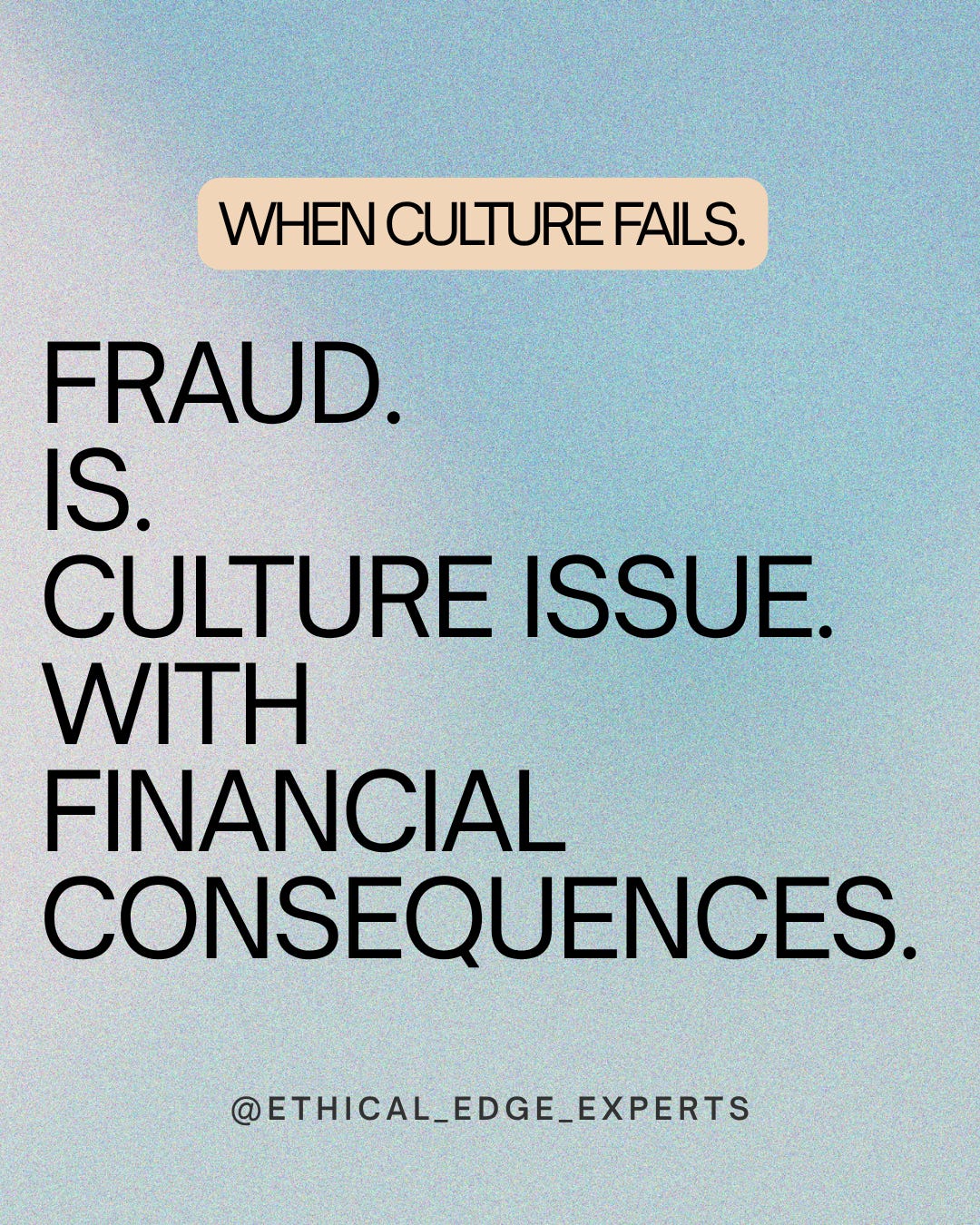
We often talk about fraud as a financial issue.
It’s not.
It’s a culture issue with financial consequences.
Controls matter.
Technology matters.
But neither replaces something simpler—and harder:
👉 A culture where people recognize risk 👉 Speak up early 👉 And act with accountability in real time
That’s not built at the top.
It’s built in the middle.
If this is something your organization is thinking about—especially how to equip managers to spot and act on risk in real time—let’s talk.
#Compliance #Ethics #FraudPrevention #InternalControls #Leadership #RiskManagement #Integrity #ToneInTheMiddle