

This time on Sevie and Evie Talk About Global Compliance, Evie Wentink and PhD. Sevie Novruzova had one of the most important conversations I think organizations need to start having:
What if compliance culture is not built at the top… but in the middle?
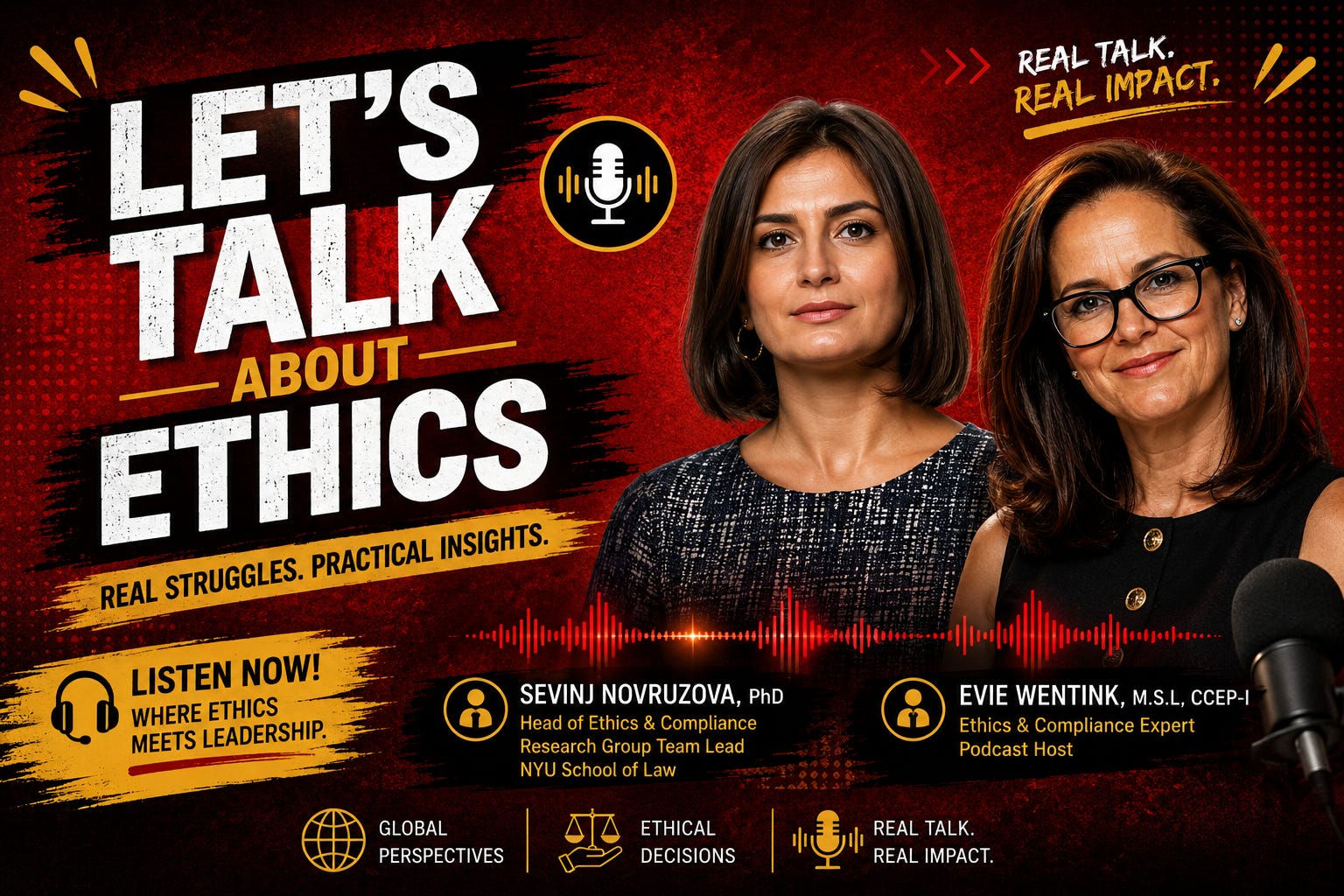
During our discussion, Sevie shared feedback from managers participating in the Integrity Playbook pilot program, and something powerful happened:
The managers stopped viewing ethics as theory.
They started viewing it as part of their daily operational decisions.
Not policy.
Not legal language.
Not “the compliance department’s problem.”
Their responsibility.
One comment from the managers stood out to me:
How do we identify and measure ethical behavior in sales teams through KPIs?
That question changes everything.
Because for years, organizations have measured:
Revenue
Performance
Productivity
Leadership skills
Delivery metrics
But rarely:
Integrity
Ethical judgment
Fairness under pressure
Escalation behavior
Speak-up leadership
We say ethics matters, but do we actually operationalize it?
That’s where the conversation becomes uncomfortable.
Most organizations still separate “performance” from “ethical leadership,” as if one can exist sustainably without the other. But the reality is this:
If managers are not trained to lead ethically under pressure, culture eventually breaks down in the gray areas.
Deadlines.
Targets.
KPIs.
Fear.
Ego.
Silence.
That is where culture is tested.
One of the strongest points from our discussion was this:
Managers want clarity.
They want practical guidance.
They want measurable expectations.
They want to know:
What ethical leadership actually looks like
How to respond to concerns
How to escalate risk
How to avoid biased decision-making
How to lead integrity conversations with their teams
And honestly? That should not surprise us.
We train managers how to drive performance.
We train managers how to hit metrics.
We train managers how to manage projects.
But many organizations never truly train managers how to lead with integrity.
That is why the Integrity Playbook matters.
Not because it teaches policy.
But because it helps operationalize ethical leadership in everyday business decisions.
One statement during the podcast especially stayed with me:
“You are expected to be an ethical leader, period—and that’s part of your job.”
Maybe that is the future of compliance culture.
Not treating ethics as a separate function.
But embedding ethical leadership directly into the expectations of management itself.
Because culture is not built during investigations.
It is built in the daily decisions managers make when nobody is watching.


